
Both compounds discussed here are investigational. Neither is an FDA-approved injectable product for muscle building, and the published evidence behind each one differs more than most marketing copy lets on. Every factual claim below is tied to a primary source. Last reviewed: June 2026.
Two research peptides, Follistatin 344 and IGF-1 LR3, are frequently presented as competing options, the implication being that a person interested in muscle-building peptides simply weighs one against the other and picks a favorite. That framing is tidy, and it is also misleading. The more useful question is not which compound “wins.” It is how much is actually known about each one, from what kind of evidence, and at what cost in risk. Looked at that way, the two compounds turn out to be far less comparable than they are usually made to sound.
What follows lays out the mechanism, the evidence, the regulatory status, and the honest limits of what can be said about either one. It resists a verdict, because the material does not support one. It should, however, leave a reader with a clearer sense of what each compound actually is.
Two mechanisms, one shared goal, opposite routes there
Follistatin 344 and IGF-1 LR3 both get associated with muscle growth, but they arrive at that outcome from different directions entirely.
Follistatin works by releasing a brake. The body limits muscle growth partly through myostatin, a member of the TGF-beta protein family whose job is to tell muscle tissue to stop expanding. The evidence for how strong that brake is comes from a 1997 study in Nature: mice with the myostatin gene knocked out grew individual muscles weighing roughly two to three times normal size, establishing myostatin as a principal regulator holding muscle mass in check [1]. Follistatin’s role is to bind myostatin and neutralize it. A 2004 paper in Developmental Biology mapped that interaction directly, showing follistatin forms a complex with myostatin and blocks its inhibition of muscle formation [2]. The logic, in short, is subtractive: remove the restraint, and growth has more room to happen.
IGF-1 LR3 works the opposite way, by adding a stimulus rather than removing a brake. It is a laboratory-modified version of insulin-like growth factor 1, a hormone the body already uses to drive tissue growth, altered so that it remains active in circulation considerably longer than native IGF-1 does. Its logic is additive: more growth signal, sustained for longer.
That difference in mechanism is not just academic. It shapes what has actually been studied, in whom, and how, and on that count the two compounds’ evidence files look nothing alike.
The research trail: one has decades of dated milestones, the other does not
It helps to see Follistatin 344’s evidence as an actual timeline, because laid out year by year, it reads less like scattered studies and more like a slow, traceable arc, one that IGF-1 LR3 simply does not have an equivalent of.
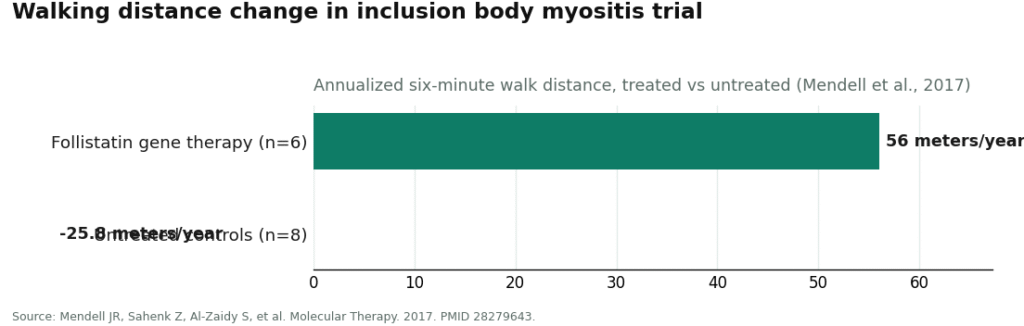
The arc starts in 1997, with the myostatin knockout mice described above, establishing the target follistatin would later be shown to neutralize [1]. It continues in 2004, with the paper characterizing exactly how follistatin binds and blocks myostatin [2]. The most consequential step comes in 2009: a study in Science Translational Medicine used an adeno-associated virus, AAV1-FS344, to deliver the follistatin gene directly into the muscles of macaque monkeys, producing durable increases in muscle size and strength with no abnormal changes to major organ structure or function [3]. From there the compound moved into small human trials, both gene therapy rather than injected peptide. In 2015, Molecular Therapy published a phase 1/2a trial in six patients with Becker muscular dystrophy; some in the higher-dose group gained as much as roughly 108 meters in six-minute walk distance at six months, alongside reduced fibrosis, though not every patient responded [4]. In 2017, a companion trial in the same journal treated six patients with inclusion body myositis, whose walking distance improved by an annualized 56.0 meters per year, compared with a 25.8-meter annual decline in eight untreated controls, a difference that reached statistical significance at p = 0.01 [5]. The trail’s most recent entry, in 2019, is not a clinical result at all but an analytical chemistry paper describing a method to detect black-market Follistatin 344, a marker of just how far the compound has traveled into unregulated commerce [6].
IGF-1 LR3 has no comparable timeline of dated, published human milestones for this specific use. The parent hormone, IGF-1, is extensively studied, and a recombinant form of human IGF-1 is an approved prescription drug, though only for a narrow pediatric growth-failure indication, nothing resembling physique or performance use. The modified analog sold under the name IGF-1 LR3, however, remains a research reagent. Its case for building muscle rests mainly on plausible mechanism and preclinical reasoning, not on a run of controlled human trials of that specific molecule. Put plainly: one compound has a short but real sequence of human gene therapy trials, with mixed results, in disease populations. The other has a well-understood parent hormone and comparatively little controlled human data on the analog itself. Neither file, read honestly, supports the confident performance claims attached to either compound in the marketplace.
The caveat that has to sit alongside every one of those Follistatin 344 numbers is that they describe gene therapy: a single viral delivery of the follistatin gene, in patients being treated for muscle-wasting disease. The results belong to an intervention that the injectable peptide vials sold online are not. Anyone impressed by “108 meters” or “56.0 meters per year” should hold onto that distinction, because it is the hinge the whole comparison turns on.
See also: The Role of Branding in Success
Where regulation and safety land, the two compounds converge again
For all their mechanistic differences, Follistatin 344 and IGF-1 LR3 share the fact that matters most to anyone deciding what to do with this information: neither is an FDA-approved injectable product for building muscle. Gene therapy and biological products require formal FDA approval before they can be marketed, and no follistatin product has met that standard [8]. The IGF-1 LR3 sold through research-chemical channels is equally unapproved for human use. In the form people actually purchase, both circulate as chemicals labeled for laboratory research, not as regulated medicine.
Safety data mirrors that gap. What reassurance exists for Follistatin 344 comes from small gene therapy trials in disease populations [3][4], and it does not transfer cleanly to repeated peptide injection in otherwise healthy people. For IGF-1 LR3, the wide-ranging activity of IGF-1 signaling across many tissue types is a longstanding reason for caution around supraphysiologic exposure, and extending the molecule’s active life in the body does not make that picture simpler. Both also face a supply problem that has nothing to do with biology: gray-market peptides are commonly underdosed, mislabeled, or contaminated. That the 2019 paper on Follistatin 344 exists at all, a method built specifically to detect black-market product, says something about how unregulated that supply chain is [6]. Comparing the two compounds on safety, in practice, means comparing two products whose real-world safety in the form actually sold is poorly characterized either way.
For anyone drug-tested, the comparison is already settled
For an athlete subject to anti-doping testing, none of the above matters, because both compounds fail the same test. The World Anti-Doping Agency prohibits myostatin inhibitors, follistatin among them, at all times, and growth factors that affect muscle, the category IGF-1 analogs fall into, are banned as well [7]. Detection science keeps advancing for both classes, including the published assay for black-market Follistatin 344 [6]. There is no version of “which one is right for my goal” that survives a testing program. For that population, the honest answer for both is no.
What can honestly be said
Set the marketing aside and the picture narrows to something like this. These are not interchangeable tools for the same job, and picking between them based on advertised muscle gains misreads the situation, since the strongest Follistatin 344 evidence is gene therapy in disease, and the case for IGF-1 LR3 in muscle building leans mostly on mechanism rather than controlled trials of the analog itself. Neither compound has the human efficacy and safety record required to say, responsibly, that it reliably and safely builds muscle in healthy adults. Both are unapproved for that purpose, and both are banned in sport.
What remains is narrower but still useful. Someone reading purely to understand the science will find Follistatin 344 the better-documented of the two in human-relevant trials, so long as the gene-therapy caveat stays firmly attached. Someone weighing whether to actually use either compound is, in both cases, weighing an investigational research chemical with thin human safety data, unreliable supply quality, and no regulatory approval. The variable that matters most in that decision is not which molecule gets picked. It is whether the decision is made under medical supervision or without it.
Where supervision enters the picture
For either compound, the gap between a supervised route and an unsupervised one outweighs the gap between the two molecules themselves. A licensed clinician who reviews a person’s history, judges whether a compound is defensible for that individual, works through a licensed compounding pharmacy, and follows up afterward changes the risk calculus considerably more than choosing follistatin over an IGF-1 analog ever could. FormBlends runs a Follistatin 344 program built along those lines: an independent prescriber, a licensed compounding pharmacy, and plain acknowledgment that compounded medications carry no FDA approval. It belongs in this discussion because it represents the supervised end of the spectrum being weighed here, not because either compound is being recommended.
The measured bottom line
Follistatin 344 and IGF-1 LR3 get treated as rivals, but they are better understood as two investigational compounds carrying evidence files of very different shapes. Follistatin 344 has a modest but genuine sequence of human gene therapy trials in muscle disease, with mixed individual outcomes and a delivery method that does not resemble the injectable products sold online [3][4][5]. IGF-1 LR3 has a well-studied parent hormone but limited controlled human data on the analog itself for muscle building. Neither is approved for that use [8], neither has solid real-world safety data, and both are prohibited in tested sport [7].
The honest answer to “which one is right for a given goal” is that the question targets the wrong variable. For understanding the science, Follistatin 344 is the better-documented compound, caveats included. For actually using either one, the route taken, supervised or not, matters more than the molecule chosen. That is the comparison worth making.
Questions worth answering
Which compound is actually better for building muscle, Follistatin 344 or IGF-1 LR3? Neither has the human evidence needed to say it reliably and safely builds muscle in healthy adults. Follistatin 344 carries the larger paper trail, but its strongest results come from a one-time gene therapy delivered in patients with muscle-wasting disease, not from injecting a peptide [3][4][5]. IGF-1 LR3’s case rests mostly on mechanism and preclinical reasoning rather than controlled trials of the analog itself, so declaring either one superior for physique goals overstates what is currently known.
Why does Follistatin 344 have a longer research history than IGF-1 LR3? Its most cited data came out of gene therapy work, where the follistatin gene was delivered once via an engineered virus, first in macaques and later in small human trials for Becker muscular dystrophy and inclusion body myositis [3][4][5]. That route drew formal clinical study because it targeted disease. IGF-1 LR3 is a research-reagent modification of a hormone whose native form is well studied, but the analog people actually buy has not gone through that same clinical arc.
Does the gene therapy data apply to someone injecting Follistatin 344 peptide? No, and that distinction is essential to keep in view. Every notable Follistatin 344 result describes a single viral delivery of the follistatin gene in people with muscle disease, not repeated peptide injections in healthy adults. The benefits and the safety signals belong to an intervention different from what is sold in vials online, so the published gains should not be assumed to carry over.
Can an athlete subject to drug testing use either compound? No. The World Anti-Doping Agency prohibits myostatin inhibitors such as follistatin at all times, and growth factors affecting muscle, the category IGF-1 analogs occupy, are banned as well [7]. Detection methods exist or are advancing for both classes, including a published assay for black-market Follistatin 344 [6]. For anyone under a testing program, the answer for both compounds is the same.
Is it legal to buy Follistatin 344 or IGF-1 LR3? Both are sold as research chemicals labeled for laboratory use, not as approved medicines, and neither is an FDA-approved injectable product for muscle building [8]. Because they travel through an unregulated supply chain, gray-market vials are commonly underdosed, mislabeled, or contaminated, a problem documented specifically for black-market Follistatin 344 [6]. Buying either one means accepting uncertain identity and purity on top of unresolved safety questions.
Does the compound matter more than how it’s used? Not really, for these two. A licensed clinician who reviews a person’s history, decides whether a compound is defensible, sources it through a licensed compounding pharmacy, and monitors afterward changes the risk picture far more than choosing follistatin over an IGF-1 analog. An unsupervised research-chemical purchase strips away every one of those safeguards, and that is the real decision point.
References
- McPherron AC, Lawler AM, Lee SJ. Regulation of skeletal muscle mass in mice by a new TGF-beta superfamily member. Nature. 1997. PMID 9139826. https://pubmed.ncbi.nlm.nih.gov/9139826/ . Myostatin knockout mice show muscles 2 to 3 times larger; establishes myostatin as the brake follistatin releases.
- Amthor H, Nicholas G, McKinnell I, et al. Follistatin complexes Myostatin and antagonises Myostatin-mediated inhibition of myogenesis. Developmental Biology. 2004. PMID 15136138. https://pubmed.ncbi.nlm.nih.gov/15136138/ . Characterizes the follistatin-myostatin binding mechanism.
- Kota J, Handy CR, Haidet AM, et al. Follistatin gene delivery enhances muscle growth and strength in nonhuman primates. Science Translational Medicine. 2009. PMID 20368179. . AAV1-FS344 gene therapy in macaques; durable gains, no abnormal organ changes. Gene therapy, not injected peptide.
- Mendell JR, Sahenk Z, Malik V, et al. A phase 1/2a follistatin gene therapy trial for Becker muscular dystrophy. Molecular Therapy. 2015. PMID 25322757. . Six patients, gene therapy; some six-minute-walk gains up to about 108 m at 6 months; reduced fibrosis; mixed response.
- Mendell JR, Sahenk Z, Al-Zaidy S, et al. Follistatin Gene Therapy for Sporadic Inclusion Body Myositis Improves Functional Outcomes. Molecular Therapy. 2017. PMID 28279643. . 6 treated vs 8 untreated; walk distance +56.0 m/yr treated vs -25.8 m/yr untreated, p = 0.01.
- Reichel C, Gmeiner G, Thevis M. Detection of black market follistatin 344. Drug Testing and Analysis. 2019. PMID 31758732. . Analytical method to detect black-market Follistatin 344; documents the unregulated supply chain.
- World Anti-Doping Agency. The Prohibited List. . Myostatin inhibitors including follistatin, and growth factors affecting muscle such as IGF-1 analogs, are prohibited at all times.
- U.S. Food and Drug Administration. Cellular & Gene Therapy Products. . Establishes that gene therapy and biological products require approval; no approved follistatin product exists.
Written by Felix Moreno, research writer. Last reviewed March 2026.
Not a substitute for medical care. Bring any new treatment idea to your healthcare provider first.